
The aviation industry worldwide is undergoing continuous transformation, driven by increasing passenger traffic, airport expansion projects, and the rising need for efficient communication systems. Modern airports are evolving into highly connected hubs where seamless coordination between aircraft, air traffic control, and ground operations is essential. Antenna systems play a critical role in enabling reliable communication, navigation, and surveillance, ensuring safe and efficient airport operations across global aviation networks.
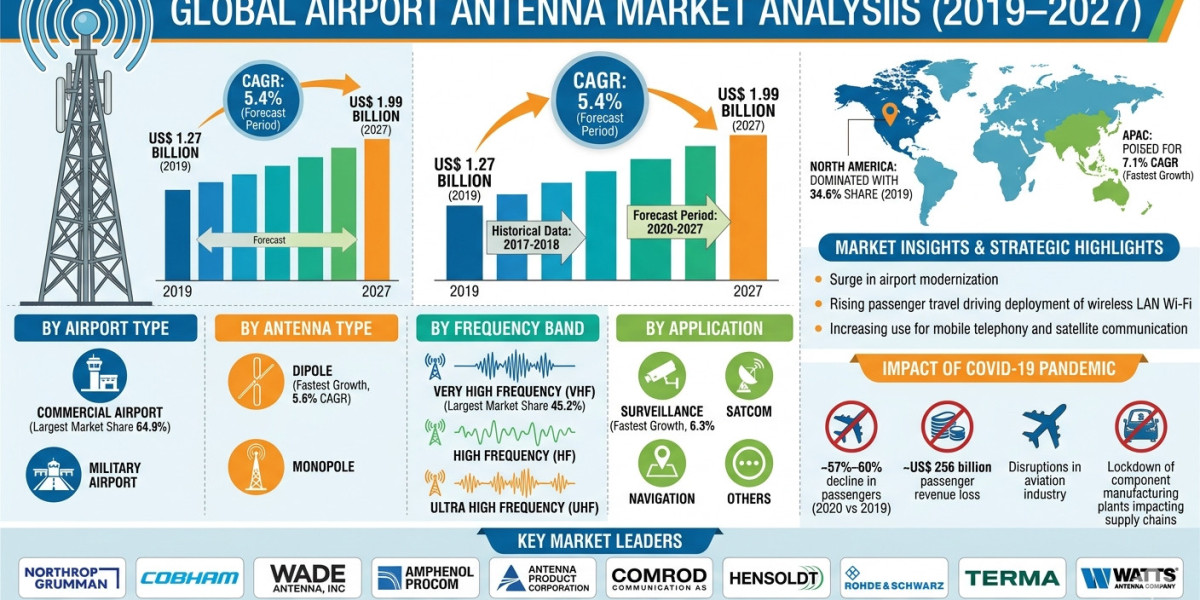
In this evolving environment, the Airport Antenna Market Insights is witnessing steady growth. The market was valued at US$ 1.27 billion in 2019 and is projected to reach US$ 1.99 billion by 2027, expanding at a CAGR of 5.4% during the forecast period. Growth is primarily driven by increasing investments in airport infrastructure, rising global air passenger traffic, and the integration of advanced communication technologies to improve operational efficiency and safety.
Download Sample PDF - https://www.theinsightpartners.com/sample/TIPRE00014280
Key Drivers Accelerating Market Growth
Expansion of Airport Infrastructure Worldwide
Governments and private stakeholders are investing heavily in the development of new airports and modernization of existing facilities. With increasing air traffic, airports require advanced communication systems to manage operations efficiently. Antenna systems are essential for supporting navigation, surveillance, and communication functions.
Rising Global Air Passenger Traffic
The steady increase in air travel is placing pressure on airport operations globally. Efficient communication between pilots and air traffic control is crucial for managing aircraft movements safely. Advanced antenna systems help streamline operations, reduce congestion, and improve overall efficiency.
Growing Emphasis on Aviation Safety and Air Traffic Control
Safety remains a top priority in aviation. Antenna systems are integral to air traffic management, enabling real-time communication and supporting surveillance technologies that track aircraft movements. These systems help ensure safe takeoffs, landings, and overall airport operations.
Adoption of Advanced Communication Technologies
Technologies such as satellite communication (SATCOM), RFID, and high-frequency transmission systems are driving modernization in airport communication infrastructure. Airports are increasingly integrating these technologies with advanced antenna systems to enhance connectivity and improve navigation accuracy.
Expansion of Commercial and Defense Aviation Sectors
The growth of both commercial and military aviation is contributing to rising demand for airport antenna systems. Commercial airports require high-capacity communication infrastructure, while military airports depend on secure and specialized systems for critical operations.
Technology Trends Shaping the Industry
The airport antenna industry is evolving with the adoption of advanced antenna types such as dipole and monopole systems. Dipole antennas are widely used for communication and surveillance, while monopole antennas support wireless networking and RFID applications.
Antennas operating across multiple frequency bands, including HF, VHF, and UHF, are essential for ensuring uninterrupted communication between aircraft and ground systems in complex airport environments.
The integration of smart technologies and automation is further enhancing system efficiency. Airports are adopting intelligent communication systems that provide real-time monitoring, predictive maintenance, and improved operational control.
Segment Insights
Commercial airports account for a significant share due to high passenger traffic and continuous infrastructure development. Military airports also represent an important segment, driven by increasing defense investments and demand for secure communication systems.
By application, antenna systems are widely used in satellite communication (SATCOM), navigation, and surveillance, all of which are critical for maintaining safe and efficient airport operations.
Competitive Landscape and Key Players
The global airport antenna industry is highly competitive, with leading players focusing on innovation, partnerships, and expansion strategies. Key companies include:
- Northrop Grumman Corporation
- Cobham Limited
- Wade Antenna, Inc
- Amphenol Procom
- Antenna Products Corporation
- Comrod Communication AS
- HENSOLDT Inc
- Rohde & Schwarz GmbH & Co.
- Terma
- Watts Antenna Company
These companies are investing in research and development and advanced technologies to strengthen their market position and meet evolving aviation requirements.
Future Outlook
The future of airport antenna systems is closely linked to the growth of global aviation and advancements in communication technologies. Increasing air traffic, combined with the adoption of technologies such as 5G, IoT, and next-generation radar systems, will further enhance airport connectivity. As airports continue to evolve into smart infrastructure hubs, demand for efficient antenna systems is expected to remain strong through 2027.
About Us
The Insight Partners is a leading global market research and consulting firm delivering actionable insights across various industries. The company provides syndicated reports, custom research solutions, and strategic consulting services to support informed decision-making and sustainable business growth.
Contact Us
For more information about this report, please contact:
The Insight Partners
Email: [email protected]
Phone: +1-646-491-9876
Related Reports -
GNSS Chips for Timing and Synchronization Market Global and Regional Share, Trends, and Growth
Interactive Display Market Global and Regional Share, Trends, and Growth